System Design面试
Design复习
Keywords for Design
Hired in Tech - System Design link
Scalability @Havard
Scalability for Dummies link
Database Sharding
系统设计面试题思路汇总 link
High Scalability公司核心技术复习
Facebook Stats
Facebook Infrastructure Facebook feeds
Tech Talks
Building applications is not a hard thing, but having the vision of the overall architecture really makes a difference. We have to crack the system interview sooner or later in our career as a software engineer or engineering manager. Interviewers are looking for future teammates that they like to work with. The future teammates are expected to be, at least, capable of solving problems independently. There are so many solutions to any given problem, but not all of them are suited given the context. So the interviewee has to specify different choices and their tradeoffs. To summarize, system design interview is a happy show-off of our knowledge on technologies and their tradeoffs. Ideally, keep talking what the interviewer expect throughout the interview, before they even have to ask. Keep talking for 45 mins could be easy, as long as we are armed with the following four steps and three common topics. Take“design Pinterest” for example. 1. Four steps to Crack the System Design InterviewBreaking down a complex task into small chunks helps us handle the problem at a better pace and in a more actionable way. 1.1 Step 1. Clarify Requirements and SpecsFirst things first, the ultimate goals should always be clear. Pinterest is a highly scalable photo-sharing service:
1.2 Step 2. Sketch Out High Level DesignDo not dive into details before outlining the big picture. Otherwise, going off too far towards a wrong direction would make it harder to even provide a roughly correct solution. We will regret wasting time on irrelevant details when we do not have time to finish the task. OK, let us sketch out the following diagram without concerning too much about the implementation detail of these components.
So far so good! To some extent, congrats, we have solved the problem! 1.3 Step 3. Discuss individual components and how they interact in detailWhen we truly understand a system, we should be able to identify what each component is and explain how they interact with one another. Take these components in the above diagram and specify each one by one. This could lead to more general discussions, such as the three common topics in Section 2, and to more specific domains, like how to design the photo storage data layout… 1.3.1 Load BalancerGenerally speaking, load balancers fall into three categories:
It is good enough to talk in this level of detail on this topic, but in case the interviewer wants more, we can suggest exact algorithms like round robin, weighted round robin, least loaded, least loaded with slow start, utilization limit, latency, cascade, etc. 1.3.2 Reverse ProxyReverse proxy, like varnish, centralizes internal services and provides unified interfaces to the public. For example, www.example.com/index and www.example.com/sports appear to come from the same domain, but in fact they are from different micro services behind the reverse proxy. Reverse proxy could also help with caching and load balancing. 1.3.3 (Frontend) Web TierThis is where web pages are served, and usually combined with the service / backend tier in the very early stage of a web service. StatelessThere are two major bottlenecks of the whole system – requests per second (rps) and bandwidth. We could improve the situation by using more efficient tech stack, like frameworks with async and non-blocking reactor pattern, and enhancing the hardware, like scaling up (aka vertical scaling) or scaling out (aka horizontal scaling). Internet companies prefer scaling out, since it is more cost-efficient with a huge number of commodity machines. This is also good for recruiting, because the target skillsets are equipped by. After all, people rarely play with super computers or mainframes at home. Frontend web tier and service tier must be stateless in order to add or remove hosts conveniently, thus achieving horizontal scalability. As for feature switch or configs, there could be a database table / standalone service to keep those states. Web Application and APIMVC(MVT) or MVVC pattern is the dominant pattern for this layer. Traditionally, view or template is rendered to HTML by the server at runtime. In the age of mobile computing, view can be as simple as serving the minimal package of data transporting to the mobile devices, which is called web API. People believe that the API can be shared by clients and browsers. And that is why single page web applications are becoming more and more popular, especially with the assistance of frontend frameworks like react.js, angular.js, backbone.js, etc. 1.3.4 App Service TierThe single responsibility principle advocates small and autonomous services that work together, so that each service can do one thing well and not block others. Small teams with small services can plan much more aggressively for the sake of hyper-growth. Service DiscoveryHow do those services find each other? Zookeeper is a popular and centralized choice. Instances with name, address, port, etc. are registered into the path in ZooKeeper for each service. If one service does not know where to find another service, it can query Zookeeper for the location and memorize it until that location is unavailable. Zookeeper is a CP system in terms of CAP theorem (See Section 2.3 for more discussion), which means it stays consistent in the case of failures, but the leader of the centralized consensus will be unavailable for registering new services. In contrast to Zookeeper, Uber is doing interesting work in a decentralized way, named hyperbahn, based on Ringpop consisten hash ring. Read Amazon’s Dynamo to understand AP and eventual consistency. Micro ServicesFor the Pinterest case, these micro services could be user profile, follower, feed, search, spam, etc. Any of those topics could lead to an in-depth discussion. Useful links are listed in Section 3: Future Studies, to help us deal with them. However, for a general interview question like “design Pinterest”, it is good enough to leave those services as black boxes.. If we want to show more passion, elaborate with some sample endpoints / APIs for those services would be great. 1.3.5 Data TierAlthough a relational database can do almost all the storage work, please remember do not save a blob, like a photo, into a relational database, and choose the right database for the right service. For example, read performance is important for follower service, therefore it makes sense to use a key-value cache. Feeds are generated as time passes by, so HBase / Cassandra’s timestamp index is a great fit for this use case. Users have relationships with other users or objects, so a relational database is our choice by default in an user profile service. Data and storage is a rather wide topic, and we will discuss it later in Section 2.2 Storage. 1.4 (Optional) Step 4. Back-of-the-envelope CalculationThe final step, estimating how many machines are required, is optional, because time is probably up after all the discussions above and three common topics below. In case we run into this topic, we’d better prepare for it as well. It is a little tricky… we need come up with some variables and a function first, and then make some guesses for the values of those variables, and finally calculate the result. The cost is a function of CPU, RAM, storage, bandwidth, number and size of the images uploaded each day.
Remember the two bottlenecks we mentioned in section 1.3.3 Web Tier? – requests per second (rps) and bandwidth. So the final expression would be Number of required servers = max(Niv/h, Nivs/b) 2 Three Common TopicsThere are three common topics that could be applied to almost every system design question. They are extracted and summarized in this section. 2.1 CommunicationHow do different components interact with each other? – communication protocols. Here is a simple comparison of those protocols.
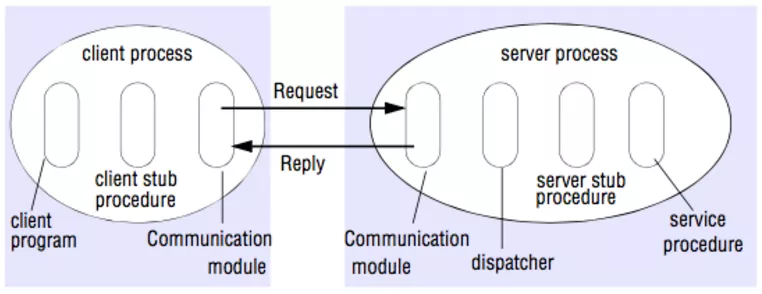
Further discussionsSince RPC is super useful, some interviewers may ask how RPC works. The following picture is a brief answer.
*Stub procedure: a local procedure that marshals the procedure identifier and the arguments into a request message, and then to send via its communication module to the server. When the reply message arrives, it unmarshals the results. We do not have to implement our own RPC protocols. There are off-the-shelf frameworks.
Generally speaking, RPC is internally used by many tech companies for performance issues, but it is rather hard to debug and not flexible. So for public APIs, we tend to use HTTP APIs, and are usually following the RESTful style.
2.2 Storage2.2.1 Relational DatabaseRelational database is the default choice for most use cases, by reason of ACID (atomicity, consistency, isolation, and durability). One tricky thing is consistency – it means that any transaction will bring database from one valid state to another, (different from the consistency in CAP, which will be discussed in Section 2.3). Schema Design and 3rd Normal Form (3NF)To reduce redundancy and improve consistency, people follow 3NF when designing database schemas:
Db ProxyWhat if we want to eliminate single point of failure? What if the dataset is too large for one single machine to hold? For MySQL, the answer is to use a DB proxy to distribute data, either by clustering or by sharding. Clustering is a decentralized solution. Everything is automatic. Data is distributed, moved, rebalanced automatically. Nodes gossip with each other, (though it may cause group isolation). Sharding is a centralized solution. If we get rid of properties of clustering that we don’t like, sharding is what we get. Data is distributed manually and does not move. Nodes are not aware of each other. 2.2.2 NoSQLIn a regular Internet service, the read write ratio is about 100:1 to 1000:1. However, when reading from a hard disk, a database join operation is time consuming, and 99% of the time is spent on disk seek. Not to mention a distributed join operation across networks. To optimize the read performance, denormalization is introduced by adding redundant data or by grouping data. These four categories of NoSQL are here to help. Key-value StoreThe abstraction of a KV store is a giant hashtable/hashmap/dictionary. The main reason we want to use a key-value cache is to reduce latency for accessing active data. Achieve an O(1) read/write performance on a fast and expensive media (like memory or SSD), instead of a traditional O(logn) read/write on a slow and cheap media (typically hard drive). There are three major factors to consider when we design the cache.
Out-of-box choices: Redis/Memcache? Redis supports data persistence while memcache does not. Riak, Berkeley DB, HamsterDB, Amazon Dynamo, Project Voldemort, etc. Document StoreThe abstraction of a document store is like a KV store, but documents, like XML, JSON, BSON, and so on, are stored in the value part of the pair. The main reason we want to use a document store is for flexibility and performance. Flexibility is obtained by schemaless document, and performance is improved by breaking 3NF. Startup’s business requirements are changing from time to time. Flexible schema empowers them to move fast. Out-of-box choices: MongoDB, CouchDB, Terrastore, OrientDB, RavenDB, etc. Column-oriented StoreThe abstraction of a column-oriented store is like a giant nested map: ColumnFamily<RowKey, Columns<Name, Value, Timestamp>>. The main reason we want to use a column-oriented store is that it is distributed, highly-available, and optimized for write. Out-of-box choices: Cassandra, HBase, Hypertable, Amazon SimpleDB, etc. Graph DatabaseAs the name indicates, this database’s abstraction is a graph. It allows us to store entities and the relationships between them. If we use a relational database to store the graph, adding/removing relationships may involve schema changes and data movement, which is not the case when using a graph database. On the other hand, when we create tables in a relational database for the graph, we model based on the traversal we want; if the traversal changes, the data will have to change. Out-of-box choices: Neo4J, Infinitegraph, OrientDB, FlockDB, etc. 2.3 CAP TheoremWhen we design a distributed system, trading off among CAP (consistency, availability, and partition tolerance) is almost the first thing we want to consider.
In a distributed context, the choice is between CP and AP. Unfortunately, CA is just a joke, because single point of failure is a red flag in the real distributed systems world. To ensure consistency, there are some popular protocols to consider: 2PC, eventual consistency (vector clock + RWN), Paxos, In-Sync Replica, etc. To ensure availability, we can add replicas for the data. As to components of the whole system, people usually do cold standby, warm standby, hot standby, and active-active to handle the failover. 3 Future StudiesJust as everything else, preparation and practice makes perfect. This article just provides limited resources for your reference. Please keep learning, and enjoy 😉
EOF |